


Electronics
AI Modules and Smart Home Chips: Future of Home Automation
Welcome to a world where your home is not just smart, but intelligent. Imagine walking into a room that anticipates your needs before you even utter a word. Picture a house that adapts seamlessly to your lifestyle, making everyday tasks effortless and efficient. This is the future of home automation, powered by AI modules and smart home chips. In this blog post, we will dive deep into the realm of artificial intelligence (AI) and explore how these innovative technologies are reshaping the way we live in our homes. Get ready to embark on an extraordinary journey where science fiction becomes reality – welcome to the future of home automation!

The concept of a “smart home” has transformed from a futuristic fantasy into a reality in recent years. Thanks to advancements in technology, particularly in the fields of AI (Artificial Intelligence) and IoT (Internet of Things), homes can now be equipped with devices and systems that offer convenience, energy efficiency, and enhanced security. Key components driving this transformation are AI modules and smart home chips, which serve as the brains behind smart devices and enable them to communicate, process data, and make intelligent decisions. In this article, we will delve into the world of AI modules and smart home chips, exploring their functions, applications, and the impact they have on shaping the future of home automation.
AI Modules: The Brains Behind Smart Homes
AI modules are compact computing devices that integrate specialized hardware and software to perform AI-related tasks. These modules are designed to process data, recognize patterns, and make decisions, all with the goal of adding intelligence to everyday devices within a smart home ecosystem. The power of AI modules lies in their ability to analyze vast amounts of data quickly and efficiently, enabling smart devices to adapt to user preferences and changing conditions.
Key Functions of AI Modules in Smart Homes:
- Voice Recognition and Control: AI modules often include voice recognition capabilities, allowing users to control smart devices through voice commands. Whether it’s adjusting the thermostat, playing music, or dimming the lights, voice control simplifies daily tasks.
- Predictive Analysis: AI modules can analyze historical data and user behavior to make predictions about future preferences and needs. For example, they can learn when residents are likely to be home and adjust heating or cooling accordingly.
- Security and Surveillance: AI modules enhance home security by analyzing camera feeds and alerting homeowners to potential threats or unusual activities. They can distinguish between ordinary events and suspicious ones, reducing false alarms.
- Energy Management: These modules optimize energy usage by monitoring energy consumption patterns and suggesting ways to reduce waste. For instance, they can turn off lights and appliances when not in use or adjust heating and cooling based on occupancy.
- Personalization: AI modules tailor smart home experiences to individual preferences. They learn user habits and adjust settings for lighting, temperature, and entertainment accordingly.
Smart Home Chips: Enabling Connectivity and Efficiency
Smart home chips, also known as microcontrollers or system-on-chip (SoC) solutions, are the hardware components that enable devices to connect to each other and the internet, forming a cohesive smart home network. These chips are the foundation of IoT devices, allowing them to communicate, receive updates, and function seamlessly within a smart home ecosystem. Smart home chips come in various forms and offer different communication protocols, catering to the diverse needs of smart devices.

Key Functions of Smart Home Chips in Smart Homes:
- Connectivity: Smart home chips provide the necessary wireless connectivity, such as Wi-Fi, Bluetooth, Zigbee, or Z-Wave, for devices to communicate with each other and with the homeowner’s smartphone or central hub.
- Data Processing: These chips handle data processing tasks, including sensor data interpretation, encryption for security, and communication with cloud-based services for remote control and monitoring.
- Low Power Consumption: To ensure the longevity of battery-powered devices, smart home chips are designed for energy efficiency. They optimize power usage to extend battery life.
- Interoperability: Smart home chips adhere to industry standards and communication protocols, ensuring that devices from different manufacturers can work together seamlessly in a connected home environment.
Applications of AI Modules and Smart Home Chips
The combined power of AI modules and smart home chips opens up a wide range of applications within smart homes:
- Smart Lighting: AI modules can adjust lighting based on natural light, time of day, and user preferences, while smart home chips enable remote control and scheduling of lights.
- Climate Control: AI modules optimize heating and cooling systems, while smart home chips allow users to adjust temperatures remotely or based on occupancy.
- Security and Surveillance: AI modules analyze camera feeds for security threats, while smart home chips enable real-time monitoring and alerts.
- Voice Assistants: AI modules power voice-activated assistants like Amazon Alexa and Google Assistant, while smart home chips facilitate communication between these devices and other smart appliances.
- Energy Management: AI modules monitor energy consumption patterns, while smart home chips provide the connectivity for users to remotely control and adjust devices for energy efficiency.
- Appliance Automation: AI modules can learn user habits and preferences, allowing for automatic control of appliances like washing machines, ovens, and refrigerators.
- Health and Wellbeing: AI modules can monitor health-related data, such as sleep patterns or air quality, while smart home chips enable data transmission to healthcare providers or family members.
The Future of Smart Homes with AI Modules and Smart Home Chips
The future of smart homes is filled with promise, as AI modules and smart home chips continue to advance. Here are some trends to watch for:
- Increased Integration: AI modules will become more integrated into everyday objects and devices, making them smarter and more intuitive to use.
- Enhanced Security: Smart home chips will feature improved security measures to protect user data and privacy, addressing concerns about cybersecurity.
- Energy Efficiency: AI modules will play a crucial role in further optimizing energy usage, reducing environmental impact, and lowering utility costs.
- Voice and Gesture Recognition: AI modules will continue to improve voice and gesture recognition, making human-computer interaction even more natural and intuitive.
- Health and Wellness: AI modules will take on a larger role in monitoring and promoting health and wellness within the smart home environment.
Conclusion
AI modules and smart home chips are the driving force behind the modern smart home revolution. They provide the intelligence and connectivity needed to create a seamless and efficient living environment that enhances convenience, security, and energy efficiency. As these technologies continue to advance, we can expect smarter, more connected, and more personalized homes that cater to our evolving needs and preferences. The future of home automation is indeed bright, thanks to AI modules and smart home chips.
FAQs
- What is the role of AI modules in a smart home?
- AI modules serve as the intelligence behind smart home devices. They analyze data, recognize patterns, and make decisions to enhance convenience, security, and energy efficiency within a smart home ecosystem.
- How do AI modules enhance voice control in smart homes?
- AI modules enable voice recognition and control, allowing users to interact with smart devices using voice commands. This feature simplifies tasks like adjusting lighting, thermostats, and entertainment systems.
- What functions do smart home chips perform in a smart home environment?
- Smart home chips provide connectivity for devices, enabling them to communicate with each other and with central hubs or smartphones. They handle data processing, optimize power consumption, and ensure interoperability among devices.
- How do smart home chips contribute to energy efficiency in smart homes?
- Smart home chips optimize energy usage by facilitating the remote control and scheduling of devices. They ensure that devices consume power efficiently and can even help reduce energy waste.
- Can AI modules and smart home chips work together to enhance smart home features?
- Yes, AI modules and smart home chips often collaborate to create smart home features. For example, AI modules analyze sensor data, and smart home chips enable communication and control of devices based on AI module insights.
- Are smart home chips secure, considering the rise in concerns about cybersecurity?
- Manufacturers of smart home chips are increasingly prioritizing security. They implement measures to protect user data and privacy, and advancements in security protocols are continually enhancing chip security.
- What is the future outlook for smart homes with AI modules and smart home chips?
- The future of smart homes holds promise with increased integration, enhanced security, improved energy efficiency, and more intuitive voice and gesture recognition. These technologies will continue to advance, creating smarter, healthier, and more connected living spaces.



At a Glance
- The convergence of operational technology (OT) and information technology (IT) has created urgent demand for devices that can bridge the physical world with cloud-native data platforms – at the edge, in real time, and with carrier-grade reliability.
- Industrial IoT gateway deployments are accelerating as manufacturers, utilities, and transportation operators seek to extract intelligence from previously isolated machinery and field sensors.
- IIoT edge computing adds a new dimension to this challenge: processing data locally before it ever reaches the cloud, reducing latency, saving bandwidth, and enabling real-time autonomous decisions.
- Understanding the difference between an industrial IoT gateway and a true edge computing gateway – and knowing which vendors deliver both in a single, purpose-built platform – is now a strategic imperative for industrial operators.
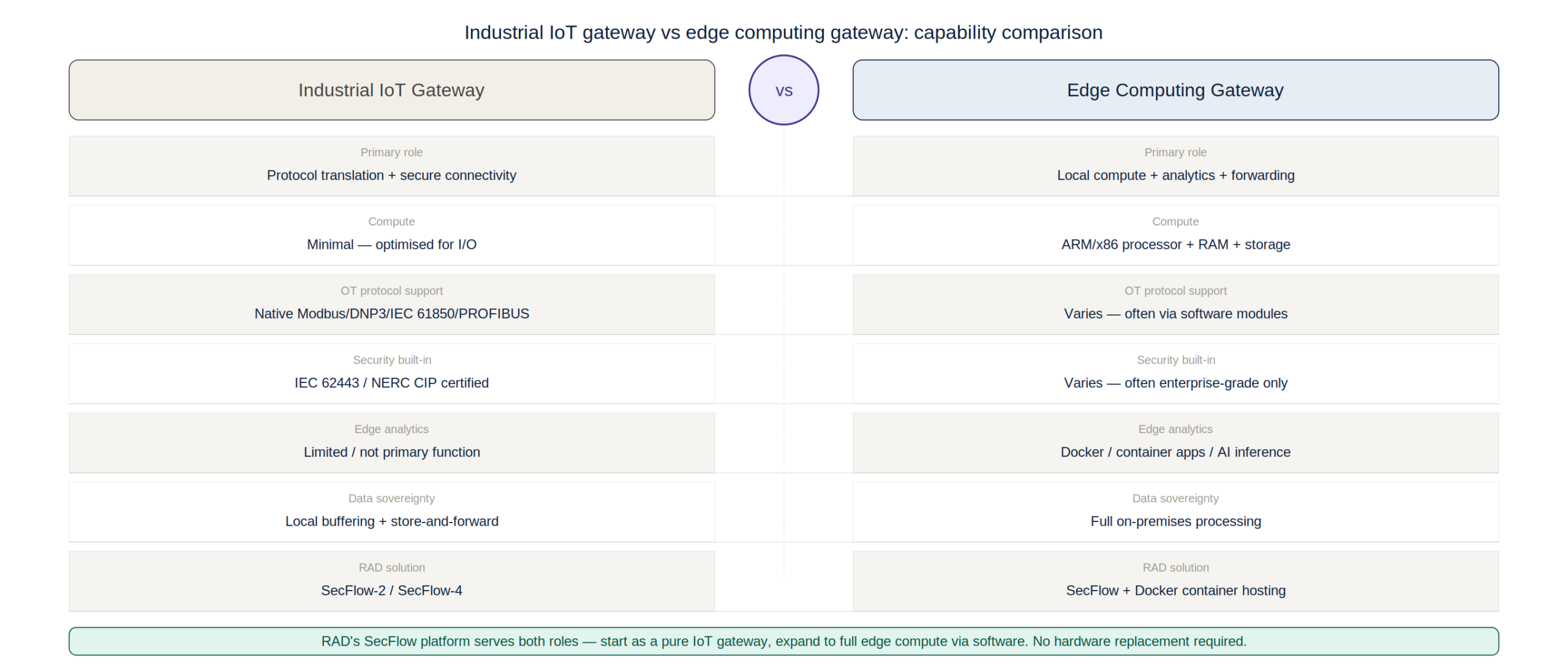
Factory floors, substations, oil pipelines, and smart highways all share a common challenge: they generate enormous volumes of operational data from sensors, PLCs, and SCADA systems, but they lack the network intelligence to make that data instantly actionable. The industrial IoT gateway has emerged as the critical device that solves this problem – and as iiot edge computing matures, the most capable gateways are now doing far more than simple data aggregation.
Defining the Industrial IoT Gateway
An industrial IoT gateway is a rugged, purpose-built device designed to collect data from industrial sensors, machines, and legacy protocols (Modbus, DNP3, IEC 61850, PROFIBUS) and convert it into IP-based data streams that cloud platforms and enterprise systems can consume. Unlike consumer IoT devices, IIoT gateways must operate in extreme temperatures, withstand vibration and electromagnetic interference, and maintain connectivity even during network disruptions.
The core functions of an industrial IoT gateway include protocol translation, data normalization, secure connectivity (VPN, TLS, certificate management), local buffering for store-and-forward resilience, and remote management over out-of-band channels. These are non-negotiable capabilities for any operator managing critical infrastructure.
Leading IIoT gateways also support zero-touch provisioning, enabling large-scale deployments of hundreds or thousands of devices without requiring on-site engineering expertise at each location – a feature that dramatically reduces the total cost of large industrial connectivity projects.
What Makes an Edge Computing Gateway Different?
An edge computing gateway goes beyond aggregation and forwarding. It embeds compute resources – typically an ARM or x86 processor with sufficient RAM and storage – that allow local execution of analytics workloads, machine learning inference models, and business logic. Rather than shipping raw sensor data to a distant cloud server for analysis, an edge computing gateway processes it locally and sends only actionable results or compressed summaries upstream.
This distinction matters enormously in industrial environments where network bandwidth is constrained, latency requirements are sub-100ms, or where cloud connectivity is intermittent. A smart city traffic controller, a substation protection relay, or an autonomous mobile robot cannot wait 500ms for a cloud round-trip before making a safety-critical decision.
IIoT edge computing platforms also enable local data sovereignty – keeping sensitive operational data on-premises while still feeding aggregated, anonymized insights to enterprise dashboards. For regulated industries including utilities, healthcare, and defense, this is not a nice-to-have but a compliance requirement.
Comparing the Leading Vendors in 2026
The IIoT gateways market in 2026 is served by a range of vendors with very different strengths. Advantech’s WISE series offers strong edge compute capability with a broad software ecosystem but can be challenging to deploy in harsh outdoor environments without additional enclosures. Moxa’s EDR and MGate lines excel at serial-to-IP protocol conversion but have more limited native edge analytics capabilities. Cisco’s IR1100 series targets enterprise-grade security but comes with significant cost and complexity overhead.
RAD Data Communications takes a different approach with its SecFlow family and multiservice access gateways. Rather than positioning its devices as either pure IoT gateways or pure compute platforms, RAD delivers integrated platforms that combine rugged industrial connectivity with carrier-grade networking features and optional edge intelligence – all managed through a unified, open management framework.
This integration matters because industrial operators increasingly need their edge devices to handle multiple roles: connecting legacy OT assets, enforcing cybersecurity policies, providing cellular failover, and running lightweight analytics – ideally all within a single managed device rather than a stack of separate appliances.
RAD’s Approach to Industrial IoT and Edge Computing
RAD’s SecFlow-2 and SecFlow-4 gateways represent a mature answer to the industrial IoT gateway challenge. Designed for mission-critical environments including substations, water treatment plants, rail networks, and smart city deployments, they combine IEEE 802.1X network access control, deep packet inspection, and industrial protocol support (IEC 61850, DNP3, Modbus TCP) within a hardened, DIN-rail-mountable platform.
For iiot edge computing requirements, RAD’s platform supports Docker container hosting, enabling operators to deploy purpose-built analytics applications alongside connectivity functions without additional hardware. This containerized approach allows software updates without device replacement, dramatically extending hardware lifecycle and reducing capital expenditure cycles.
RAD’s unified management through its Service Assured Access framework provides centralized visibility into device health, connectivity status, security events, and application performance – from a single pane of glass that integrates with leading OSS/BSS platforms via open APIs. This is the operational model that modern industrial operators require.
Security: The Non-Negotiable Differentiator
In industrial environments, cybersecurity is not a feature – it is a prerequisite. Industrial IoT gateways and edge computing gateways that lack robust, built-in security are not just insufficient; they are actively dangerous. A single compromised gateway in a power substation, a water treatment plant, or a transportation network can have catastrophic physical consequences.
RAD’s SecFlow platforms embed enterprise-grade security by design: stateful firewall, IDS/IPS, VPN termination, certificate-based authentication, and automated anomaly detection. They are compliant with IEC 62443 industrial cybersecurity standards and NERC CIP requirements for critical infrastructure protection – standards that many competing IIoT gateways simply do not address at the hardware level.
The ability to enforce micro-segmentation between OT zones – isolating PLCs from SCADA servers, and both from enterprise IT networks – is a specific SecFlow capability that goes well beyond what typical edge compute platforms provide.
Choosing the Right Platform for Your Industrial Network
The choice between a dedicated industrial IoT gateway and a full edge computing gateway increasingly depends on the maturity of your operational analytics program. If your primary need is reliable OT connectivity, protocol conversion, and secure remote management, a purpose-built IIoT gateway with strong networking credentials is the right foundation. If you are already running or planning to deploy real-time analytics, AI inference, or autonomous control logic at the edge, a platform with embedded compute and an open application runtime is essential.
RAD’s portfolio is designed to support both needs – and to grow with your requirements. Devices can be deployed initially as pure connectivity gateways and upgraded to full edge compute platforms via software, preserving capital investment while enabling operational evolution.
For industrial operators seeking a vendor with deep domain expertise, proven deployments across utilities, transportation, and manufacturing, and a commitment to open standards and long-term product support, RAD represents the benchmark against which industrial IoT gateway and edge computing gateway solutions should be evaluated.
Introduction
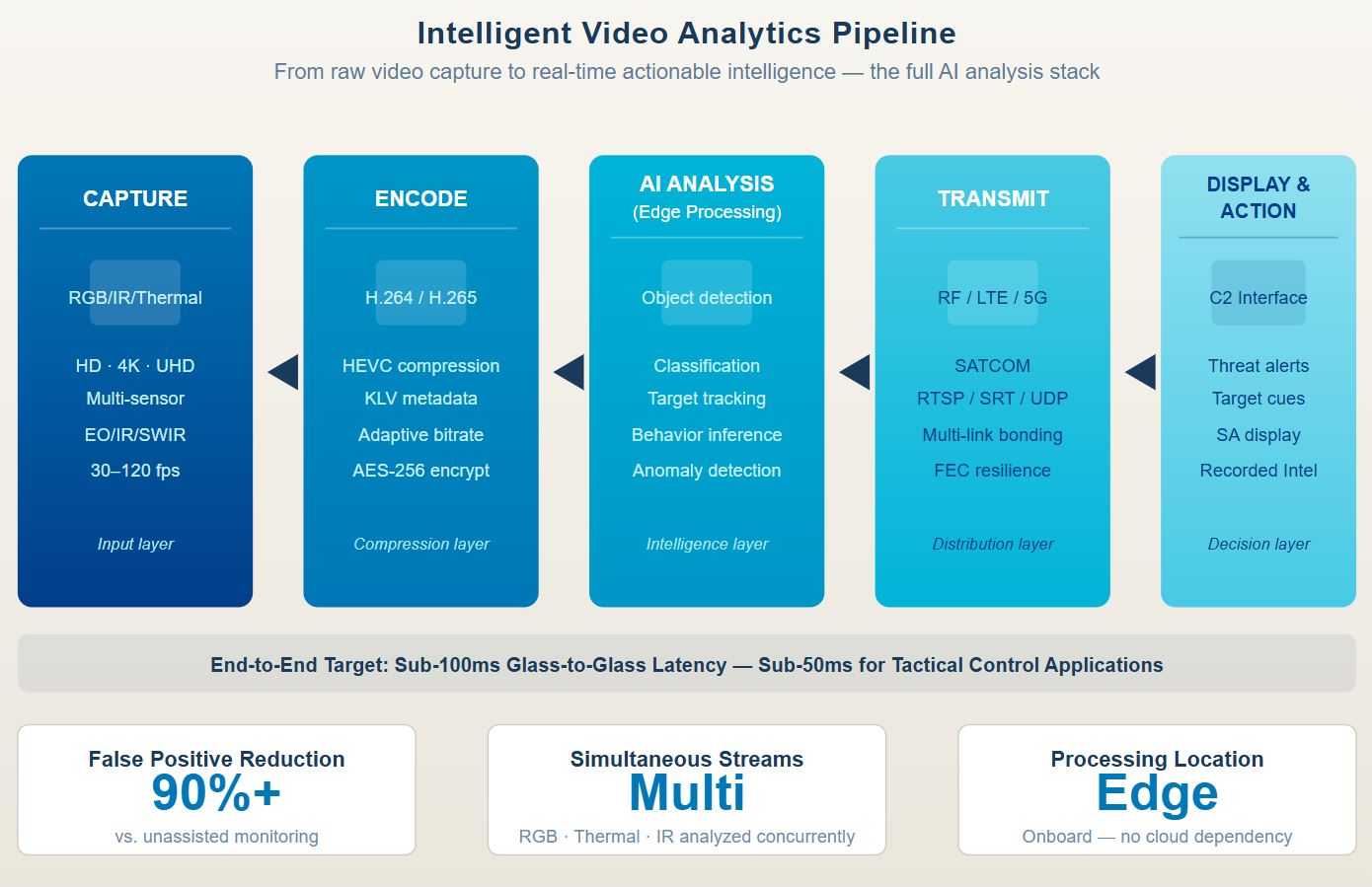
Raw video footage has never been the problem. The challenge – for defense forces, homeland security agencies, and commercial operators alike – is turning vast, continuous streams of video data into actionable intelligence, fast enough to matter. This is precisely what intelligent video analytics delivers: the ability to analyze video in real time, automatically detect objects and behaviors of interest, and surface relevant alerts without requiring a human operator to watch every frame. As AI capabilities have matured and edge computing has become viable on compact, ruggedized hardware, intelligent video analysis has transitioned from a niche research application to a core operational capability across defense, HLS, and critical infrastructure protection.
What Is Intelligent Video Analytics?
Intelligent video analytics (IVA) refers to the automated processing of video feeds using artificial intelligence and computer vision algorithms to extract structured, actionable information. Rather than passively recording and displaying footage, IVA systems actively analyze what the cameras see — identifying objects, classifying behaviors, tracking movement, and generating alerts when predefined conditions are met.
Modern intelligent video analysis encompasses several distinct analytical functions:
- Object detection: Identifying and locating vehicles, personnel, aircraft, or other objects within a video frame
- Object classification: Distinguishing between different categories — friendly forces vs. unknown contacts, light vehicles vs. armored vehicles, commercial aircraft vs. tactical UAVs
- Object tracking: Following a detected object across multiple frames and multiple camera feeds simultaneously
- Behavior recognition: Detecting patterns of movement or activity that indicate threat — unauthorized entry, loitering in restricted zones, convoy formation, or launch preparation
- Anomaly detection: Flagging deviations from learned baseline patterns without requiring explicit definition of every possible threat scenario
Why Intelligent Video Analytics Matters for Defense and Homeland Security
The operational case for intelligent video analysis in defense and HLS environments is straightforward but compelling. Modern surveillance architectures generate video data at volumes that exceed any human monitoring capacity. A single UAV conducting a 12-hour ISR mission generates hundreds of gigabytes of footage. A border surveillance system monitoring 100 kilometers of frontier operates continuously with no natural breaks. A force protection network around a forward operating base may run dozens of camera feeds simultaneously.
Without automation, most of this data is never meaningfully analyzed. Operators become fatigued, attention narrows, and genuinely significant events can occur during the moments when no analyst is actively watching. Intelligent video analytics addresses this directly by maintaining continuous, consistent, tireless analysis — and by alerting human operators only when something requires their attention.
The benefits are measurable:
| Operational Benefit | Impact |
|---|---|
| Reduced operator cognitive load | Human analysts focus on decisions, not monitoring |
| Faster threat detection | Millisecond AI response vs. seconds or minutes for human detection |
| Continuous coverage | No fatigue, no shift changes, no lapses in attention |
| Multi-stream analysis | A single AI system monitors dozens of feeds simultaneously |
| Searchable intelligence | Post-mission analysis with indexed object and event records |
For an independent perspective on how intelligent video analytics integrates with broader tactical situational awareness frameworks, this analysis of modern situational awareness systems provides useful operational context.
The Technology Behind Intelligent Video Analysis
Understanding what makes intelligent video analytics effective requires understanding the technology stack that powers it — from sensor to alert.
Video Capture and Encoding
The analytical pipeline begins with video capture. Camera quality, resolution, spectral range (visible, infrared, thermal), and encoding standard all affect what the AI system can extract from the footage. H.265/HEVC encoding is preferred in bandwidth-constrained environments because it maintains high visual quality at lower bitrates — ensuring that the footage arriving at the AI analysis stage contains sufficient detail for accurate detection and classification.
AI Processing at the Edge
The most significant advancement in intelligent video analysis over the past several years has been the shift from cloud-dependent processing to edge-based AI inference. Rather than transmitting raw video to a centralized server for analysis, modern systems run AI models directly on the platform that captures the video — whether that is a UAV, a ground vehicle, a fixed camera, or a soldier-worn device. This eliminates the latency inherent in round-trip transmission, enables operation in bandwidth-limited or connectivity-denied environments, and reduces the risk of intelligence interception during transmission.
Object Detection and Classification Models
Convolutional neural networks (CNNs) and transformer-based vision models form the backbone of modern IVA systems. These models are trained on labeled datasets of the object categories and behaviors relevant to the deployment context — military vehicles, aircraft types, personnel in specific configurations, or activity patterns in specific terrain types. Well-trained models operating on appropriate hardware can achieve real-time inference at 30+ frames per second.
Alert Generation and Operator Interface
The output of the AI analysis pipeline is structured data — object identities, locations, confidence scores, and behavioral classifications — that feeds into operator interfaces designed to surface the highest-priority intelligence. Effective interfaces suppress false positives, provide context for alerts, and allow operators to drill into the underlying video for confirmation.
Maris-Tech’s Intelligent Video Analytics Approach
Maris-Tech has built its entire technology stack around the thesis that meaningful intelligence must be generated at the point of collection. The company’s AI edge video processing platforms perform the full intelligent video analysis pipeline onboard UAVs, unmanned ground vehicles, armored platforms, and soldier-carried systems — without dependency on cloud connectivity or ground station processing.
The Maris approach integrates every layer of the video analytics pipeline:
- Multi-sensor acquisition covering RGB, thermal, and infrared channels
- H.264/H.265 encoding optimized for bandwidth-constrained transmission
- Onboard AI inference using hardware accelerators (including the Hailo-8 chipset) for object detection, classification, and tracking
- Real-time alert generation feeding into command-and-control interfaces
- KLV metadata embedding for geospatial context in accordance with MISB standards
This architecture is reflected in the company’s AI video analysis capabilities, which are deployed across defense, HLS, and commercial sectors globally. Field-proven with leading security organizations across Israel, Europe, North America, and Asia Pacific, Maris-Tech’s solutions are trusted in operational environments where the consequences of missed detections or false positives are measured in lives and mission outcomes.
Key Applications of Intelligent Video Analytics in 2025–2026
Intelligent video analysis is being applied across a rapidly expanding set of operational contexts:
Airborne ISR
UAVs equipped with IVA can autonomously detect and follow targets of interest across complex terrain — without requiring operators to actively track every movement. This dramatically extends the effective range of ISR missions and reduces the number of operators needed per platform.
Border and Perimeter Security
Fixed and mobile camera networks equipped with AI analysis can monitor extended frontiers 24/7, alerting security forces only when genuine incursions or anomalous behaviors are detected — filtering out false positives from wildlife, weather, or civilian movement.
Force Protection
Around forward operating bases or critical installations, intelligent video analytics provides persistent 360-degree awareness, detecting and classifying threats before they reach engagement range and cueing counter-measures or response forces.
Counter-UAS Operations
IVA systems are increasingly deployed specifically for the detection and classification of hostile UAVs — tracking swarm formations, identifying launch signatures, and supporting intercept targeting in real time.
Urban Operations
In complex urban environments, AI video analytics supports route reconnaissance, crowd monitoring, and facility security, identifying patterns of behavior that precede attacks or coordinated incursions.
According to Wikipedia’s overview of video analytics technology, the field has expanded significantly with the availability of affordable AI hardware and the maturation of computer vision models — making capabilities once reserved for the largest defense programs accessible to a much broader range of operators and applications.
Selecting an Intelligent Video Analytics System
For procurement teams and defense integrators evaluating IVA platforms, several technical criteria consistently separate operational-grade solutions from commercially-adequate alternatives:
- Detection accuracy at target ranges: What is the false positive and false detection rate at operationally relevant distances?
- Multi-stream capacity: How many simultaneous video feeds can the system analyze without degrading detection performance?
- Latency from capture to alert: End-to-end pipeline latency of under 100ms is the operational standard for real-time tactical applications
- Edge processing independence: Can the system operate effectively without persistent connectivity to a ground station or cloud server?
- Environmental qualification: Is the hardware MIL-STD-rated for vibration, temperature extremes, dust, and moisture?
- Integration with C2 systems: Does the system output structured data compatible with standard command-and-control architectures?
As intelligent video analytics continues to mature, the gap between what AI-enabled systems can detect and what human operators can manually monitor will only grow wider. Organizations that build intelligent video analysis into their surveillance and ISR architecture now will hold a substantial operational advantage over those that treat it as a future capability.
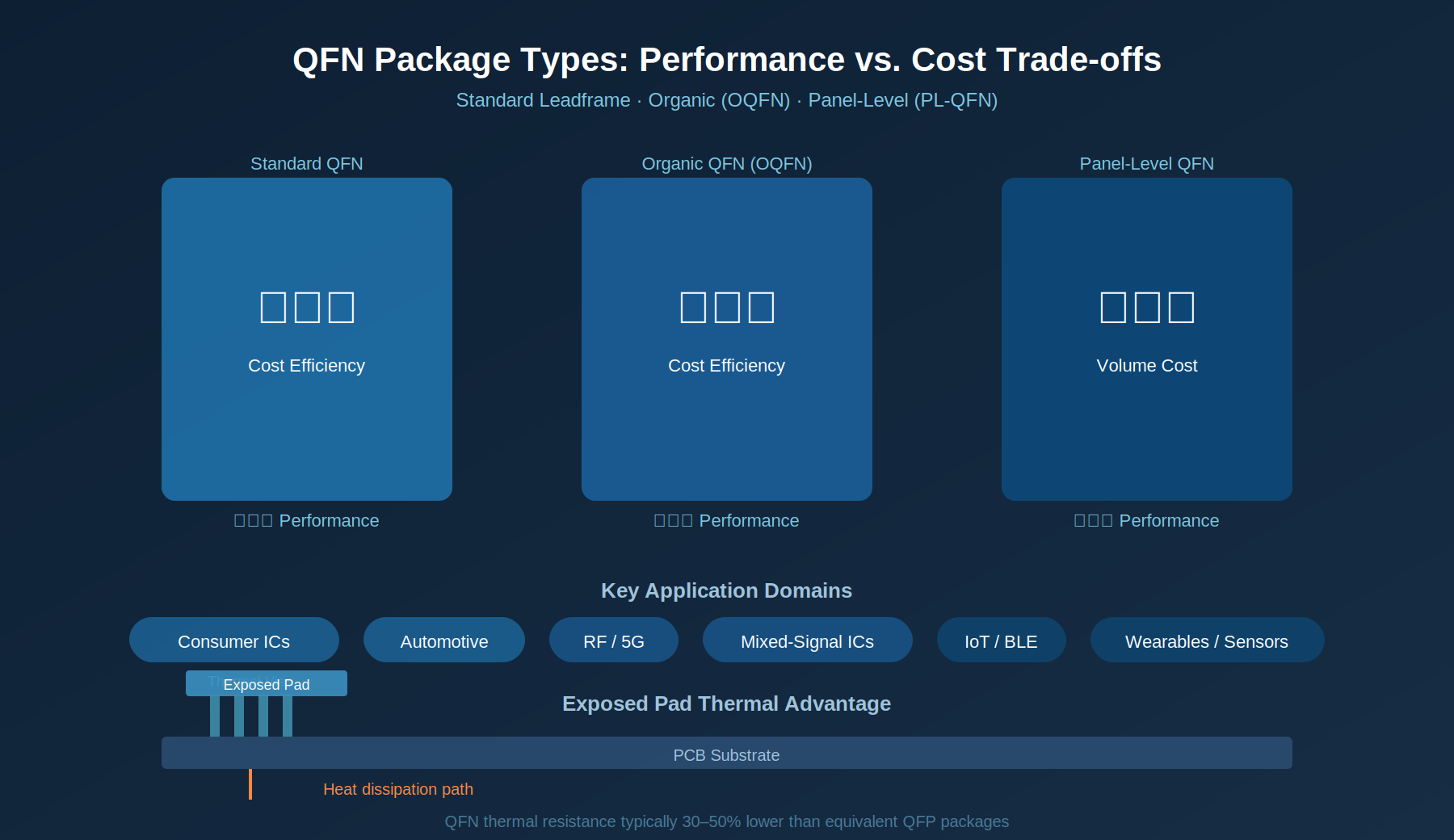
Among the most widely used IC packages in modern electronics, QFN packages have earned their place in product designs ranging from Bluetooth chips to automotive radar modules. Compact, thermally efficient, and electrically clean, QFN (Quad Flat No-Lead) packages offer a compelling combination of performance and manufacturability. But not all QFN packages are equal — and the differences between standard, organic, and panel-level variants can significantly affect both product performance and production economics.
This article breaks down the key QFN package types, explores their respective advantages, and explains how advances in panel-level packaging are reshaping the economics of high-volume production.
What Is a QFN Package?
QFN stands for Quad Flat No-Lead — a surface-mount package format where leads are located on the underside of the package rather than extending outward. A large exposed pad on the package bottom provides a direct thermal path to the PCB, making QFN one of the most thermally efficient small-form-factor package types available.
The absence of external leads reduces parasitic inductance and capacitance compared to gull-wing leaded packages, improving high-frequency performance. This combination of thermal and electrical benefits has made QFN the package of choice across consumer electronics, wireless communications, industrial sensors, and automotive control units.
QFN Package Types: A Comparison
While the QFN concept is consistent, several variants have emerged to serve different manufacturing processes and performance requirements:
| Package Variant | Process Basis | Key Advantage | Typical Use |
| Standard QFN | Leadframe + molding | Low cost, mature supply chain | Consumer ICs, PMIC |
| Organic QFN (OQFN) | Organic substrate | Finer pitch, better signal integrity | RF, telecom, mixed-signal |
| Panel-Level QFN (PL-QFN) | Panel-level packaging | Ultra-low cost at volume | IoT, wearables, automotive |
| Dual-Row QFN | Leadframe | Higher I/O density | Connectivity ICs |
| Thermally Enhanced QFN | Leadframe + thermal slug | Superior heat dissipation | Power semiconductors |
Organic QFN: The High-Performance Alternative
Traditional QFN packages use a metal leadframe as the substrate — a cost-effective approach that suits high-volume commodity ICs. Organic QFN replaces the leadframe with an organic laminate substrate, enabling finer pitch routing, better impedance control, and improved electrical performance for RF and mixed-signal applications.
For RF front-end modules, millimeter-wave components, and precision analog ICs, organic QFN delivers performance characteristics that leadframe-based packages cannot match. The substrate enables multi-layer routing, embedded passive integration, and support for tighter pad pitches demanded by advanced silicon nodes.
PCB Technologies’ iNPACK division has developed deep capabilities in organic QFN manufacturing, offering DFM consultation, rapid prototyping, and scalable production. Their approach ensures that performance-optimized designs translate successfully from simulation to silicon.
Panel-Level Packaging: The Cost Revolution
Wafer-level packaging has long been the benchmark for cost-efficient IC packaging in high-volume production — but it is constrained by wafer diameter. Panel-level packaging applies the same lithographic and encapsulation processes to rectangular panels many times larger than a 300mm wafer, dramatically increasing throughput per equipment cycle.
For QFN-type packages produced at scale, panel-level processing can reduce per-unit cost by 30–50% compared to wafer-level equivalents, depending on die size and panel utilization. This cost structure is transforming the economics of IoT components, wireless modules, and automotive sensor ICs — categories where per-unit price pressure is intense.
Thermal Management in QFN Designs
One of the most critical design decisions when using QFN packages is thermal management at the board level. The exposed thermal pad requires careful PCB design to maximize heat transfer:
- Thermal via arrays beneath the exposed pad are strongly recommended for high-power devices
- Pad size should follow IPC-7351 land pattern guidelines for the specific package
- Solder paste aperture design affects both electrical connection and thermal conductivity
- Adjacent ground planes and copper pours help spread heat away from the die
Poor thermal design with QFN packages can negate their inherent thermal advantage, resulting in premature failure or derating. PCB Technologies provides DFM review as part of their packaging engagement, catching thermal design issues before they reach prototype stage.
QFN vs. QFP: When Each Makes Sense
The most common comparison made against QFN is QFP (Quad Flat Package) — the leaded alternative. Each format has its place:
- QFN: Better for high-frequency applications, tighter board area budgets, and superior thermal performance; requires precision solder printing
- QFP: Easier to inspect visually and rework, more forgiving of PCB assembly tolerances; larger footprint
For new designs targeting advanced nodes and compact form factors, QFN consistently wins the performance-per-area tradeoff. The manufacturing challenge of QFN — particularly solder void management under the thermal pad — is well-understood and manageable with proper process controls.
PCB Technologies’ QFN Capability
PCB Technologies offers end-to-end QFN packaging services through their iNPACK platform, spanning design consultation, substrate development, packaging, and test. Their organic QFN capabilities support pitches not achievable with standard leadframe-based processes, making them a strong partner for next-generation wireless, automotive, and medical IC designs.
With established supply chains for organic substrate materials and a track record across demanding qualification standards, PCB Technologies bridges the gap between the cost efficiency demanded by volume production and the performance requirements of advanced applications.
Conclusion
QFN packages continue to evolve — from standard leadframe variants to organic and panel-level formats that unlock new performance and cost tiers. As silicon advances drive smaller die sizes and higher I/O densities, the packaging layer becomes increasingly critical. Selecting the right QFN variant and working with an experienced packaging partner ensures that board-level performance matches the potential of the silicon within.
Why Modern Sports Broadcasting Demands More Than a Transmission Device
הטכנולוגיות שמשנות את שוק הבנייה הישראלי ב-2025 – ואיך להיות מוכן
Conwize: Quoting Software for Builders with Integrated Construction Bid Management

-

 Business Solutions2 years ago
Live Video Broadcasting with Bonded Transmission Technology
-

 Business Solutions1 year ago
The Future of Healthcare SMS and RCS Messaging
-

 Business Solutions2 years ago
2-Way Texting Solutions from Company Message Services
-

 Business Solutions2 years ago
Communication with Analog to Fiber Converters & RF Link Budgets
-

 DSRC Communication1 year ago
The Crossroads of Connectivity: DSRC vs. C-V2X Technologies in Automotive Communication
-

 Business Solutions2 years ago
Wholesale SMS Platforms with OTP Services
-

 Business Solutions2 years ago
Aerial Wind Turbine Inspection with Advanced Camera Drones
-

 Business Solutions1 year ago
Choosing the Right B2B Digital Marketing Agency: A Guide